
The brain
Predicts the next token.
The body
Builds the request, runs the tools, keeps state.
The method
Act, read the result, act again, until done.
The judgement
Set the job, approve the step, read the result.
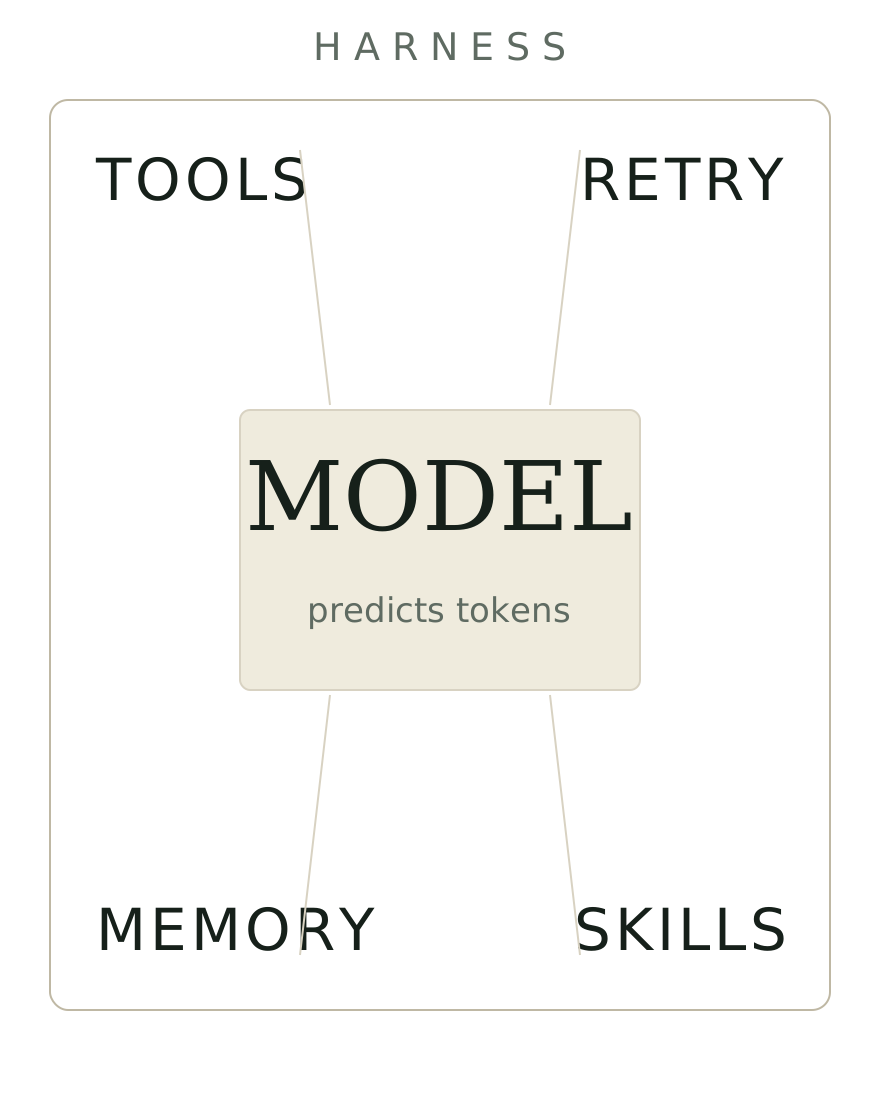
The model, the harness, and five harnesses side by side.
Predicts the next token.
Builds the request, runs the tools, keeps state.
Act, read the result, act again, until done.
Set the job, approve the step, read the result.

One call in, one answer out. A model itself is stateless.
The conversation is resent on every call. Drop it and the model has never met you.
It cannot open a file, run a command or wait. It can only ask.
It writes what is plausible, not what is checked. This is why every harness retries.
Timeouts, rate limits, a bad key. One call is not a promise.
Read, write, run, browse. The model asks; the harness runs.
shell · files · webRead the error, change the call, run it again.
until the check passesA file that outlives the session. The next run starts here.
between sessionsWritten down once, loaded only when it applies.
written, not trainedHarness Engineering is about systems, you’re building tooling around the model to optimize goals like task performance, token efficiency, latency, etc. Design decisions include the system prompt, tool choice, and execution flow.
| Harness | Made by | What it is for |
|---|---|---|
| Claude Code | Anthropic | Coding, in a terminal and an IDE |
| Codex CLI | OpenAI | Coding, in a terminal and a ChatGPT plan |
| Cursor | Anysphere | Coding, inside the editor |
| OpenCode | Anomaly | Coding, open source, any model |
| Hermes Agent | Nous Research | Any work, not only code |
Basic Intro.
The self-improving AI agent.
The only agent with a built-in learning loop: it creates skills from experience, improves them during use, nudges itself to persist knowledge, and builds a deepening model of who you are across sessions.
| Claude Code | Codex | Hermes | |
|---|---|---|---|
| Built for | Coding, in Anthropic's stack | Coding, in a ChatGPT plan | General work that includes code |
| Models | Claude only | OpenAI only | Any provider, swapped mid-session |
| Reaches you in | Terminal, IDE, cloud | Terminal, IDE, ChatGPT | Terminal, desktop, browser, chat, cron |
| Lock-in | Vendor and model | Vendor and model | Neither: your harness, your model |
Say what you want to build. Get a deployed app and a link you can send.
It reads the new postings, keeps the ones matching your CV, and messages you.
Ask for slides. Get a deck that opens in a browser and stays editable.
It searches in parallel, then hands you a cited outline you still have to check.
Meeting notes go in. Tasks with owners and dates come out, chased on chat.
Twelve files with useless names become twelve named files and one index.
It runs the code, reads the error, and fixes it or tells you what broke.
Chapters summarised, then questions until you stop getting them wrong.
Hand it the syllabus once. Due dates and reminders go in for you.
Flights, tickets, a visa slot: checked daily until something moves.
| Feature | What it is |
|---|---|
| Persistent memory | Facts about you and your work outlive the session that produced them. |
| Learning loop | After the task it writes the procedure down as a skill, and loads it next time. |
| Messaging platforms | One agent on Telegram, Discord, Slack, WhatsApp, Signal, email. |
| Scheduled jobs | A job runs on a timer with nobody watching and messages you the output. |
| Subagents | Splits one job across child agents that work in parallel and report back. |
| Browser control | Drives a real browser: fills forms, clicks through, reads the page. |
| Feature | What it is |
|---|---|
| Voice | You talk, it answers aloud. Hands free, same agent. |
| Code execution | Runs Python in a sandbox for data work and scripts, mid-conversation. |
| Multi-agent board | Named agent profiles share one task board and pick up each other's cards. |
| Skill marketplace | Search a registry, read the skill, install it, audit it before it runs. |
| Model switching | Any provider, swapped mid-session, with a fallback chain behind it. |
| MCP and plugins | Plugs into outside tools over an open protocol. About sixty tools built in. |
| Local models | Runs on Ollama or llama.cpp on your own laptop, with no API bill. |
| Source | What it is | Who puts it there |
|---|---|---|
| Bundled | Get during installing, ready to use | The installer |
| Optional | Sit in the repository, available for opt-in | You |
| Marketplace | Any skill from a registry, pulled on request | You |
Only the name and description sit in the prompt; the body is read when the skill is used.
| Path | When it fires | What it does |
|---|---|---|
| Foreground | The agent decides mid-task, or you ask it outright | Create, patch, add a support file, delete. Always available, straight into the live library |
| Creation nudge | Every few turns, 10 by default | A prompt to consider writing the procedure down. Set the interval to 0 and it stops |
| Review fork | After every turn | A forked agent re-reads the turn and asks what is worth saving. The only path that marks a skill agent-written |
| Curator | After days with no use | Nothing new. It moves a skill from active to stale to archived, and never deletes |
The background pass writes to the same store you read. No staging copy, no diff to approve.
A bundled or marketplace skill takes the same patch as one you wrote. Only deletion asks where it came from.
Install keeps a hash per skill. Change the file and the next update skips it, quietly, for good.
Three commands name it and undo it: list-modified, diff, reset. Only curator lock holds against the agent.
Commands and counts: Hermes Agent v0.23.0 on this machine · 10 Nov 2026
| Skills | Memory | |
|---|---|---|
| What | Procedural knowledge: how to do things | Factual knowledge: what things are |
| When | Loaded on demand, only when relevant | Injected into every session automatically |
| Size | Can be large (hundreds of lines) | Should be compact (key facts only) |
| Cost | Zero tokens until loaded | Small but constant token cost |
| Examples | "How to deploy to Kubernetes" | "User prefers dark mode, lives in PST" |
| Who creates | You, the agent, or installed from Hub | The agent, based on conversations |
One background process, the gateway. The same agent answers in every app you already use.
Also Telegram, Slack, Signal, SMS, email, Matrix, Microsoft Teams, iMessage, IRC.
hermes gateway install registers a launchd or a systemd service. The bot answers while the machine is awake.
The same install on a VPS. It answers with your laptop shut.
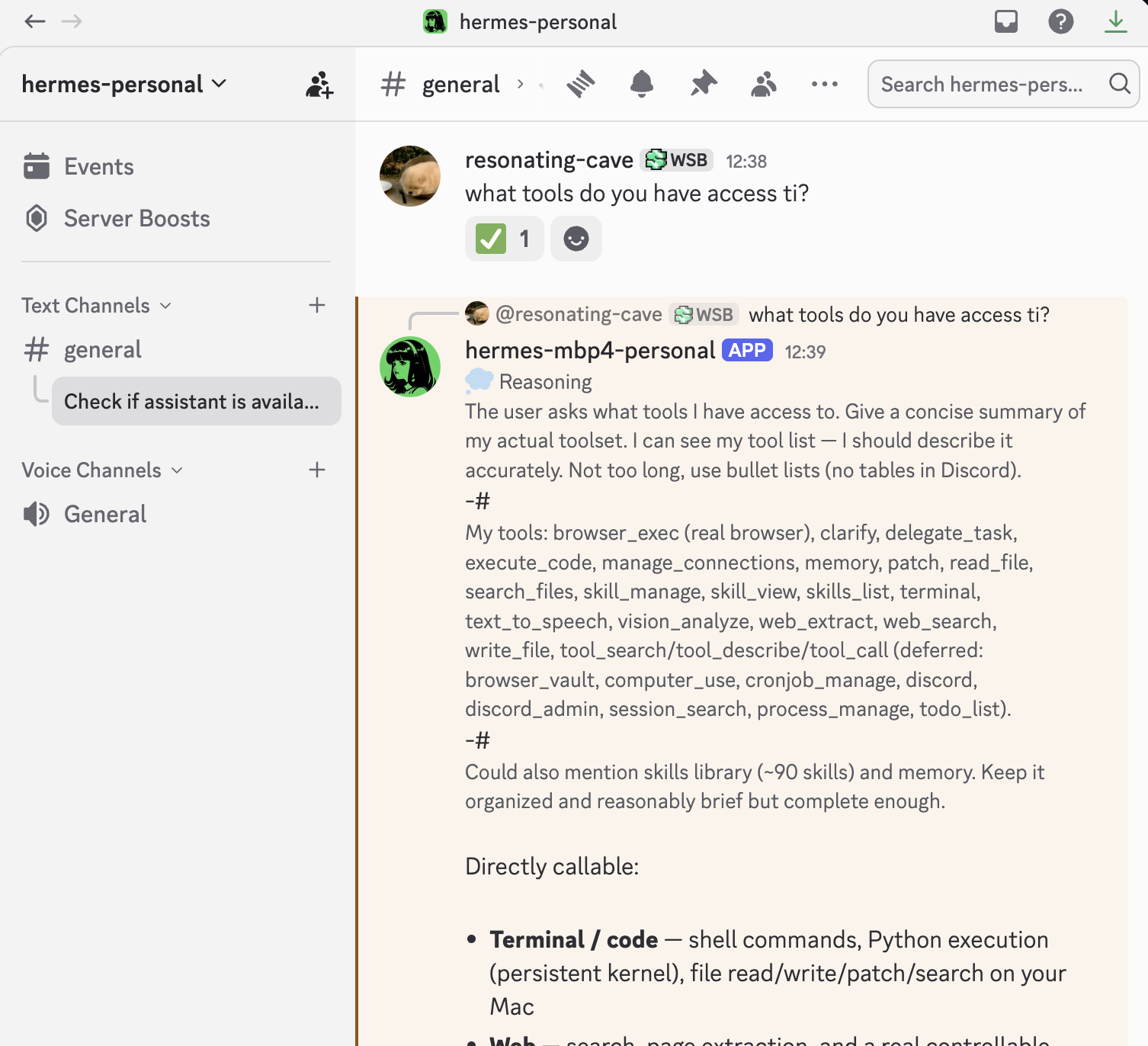
The three tools, the six settings, then the demo runs live.
Runs the loop, on your machine.
the agent
One key, and the model behind it.
the models
Where you message it, from anywhere.
the chat
Get a bot token.
Invite it.
hermes gateway setupWalks the whole thing and prints your invite link.
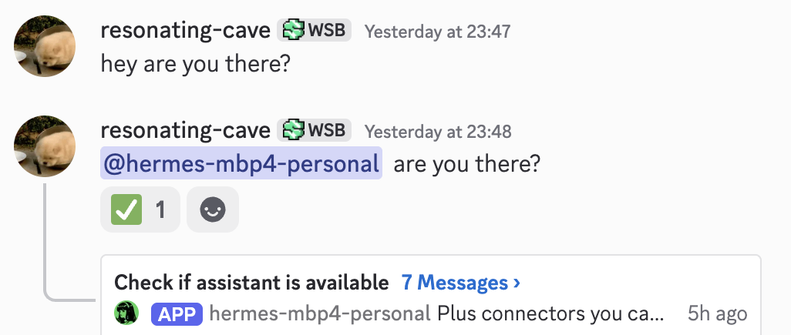
It replies in a new thread, and that thread is its own private session. Inside it, no mention needed.
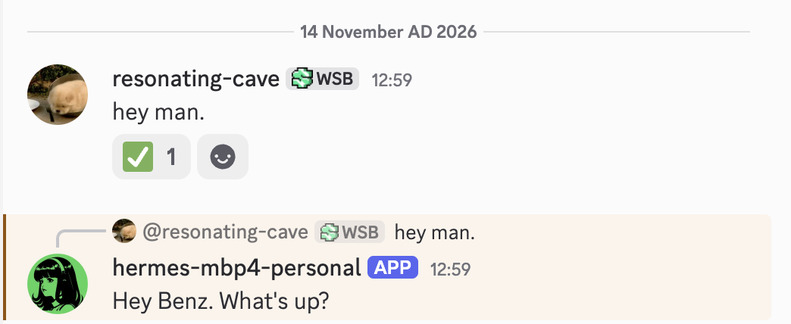
In a DM, just talk. History stays in Discord; the context compacts as it fills, so nothing is lost.
The Challenge
Use Hermes Agent to create a website to showcase your profile.
Outcome = your-username.github.io.
Free to host, no server to run.
You can open it and edit it yourself.
The agent does the heavy work. You order and review.
Repo and Version control.
Access LLM.
Chance to learn where AI goes right, and where it goes wrong.